
A dental implant is a small titanium post placed in the jawbone to act as an artificial tooth root, which then supports a custom-made crown that looks, feels, and works much like a natural tooth. For most adults with one or more missing teeth, healthy gums, and enough bone, it’s one of the most long-lasting ways to fill a gap. If you’ve just had a tooth taken out, or lost one, and you’ve been lying awake wondering what to do about the space, this is for you. We’ll go through what an implant is, who it suits, what can go wrong, and what it costs, so you’re not deciding on guesswork.
The short version
- An implant replaces the tooth root as well as the crown
- The bone grows onto the post over about three to six months
- Best suited to adults with healthy gums and enough jawbone
- Gum disease, smoking and some medical conditions need sorting first
- Placed under local anaesthetic, with happy gas if you are anxious
- You get a treatment plan with costs laid out before anything starts
What Is a Dental Implant?
Every tooth has two parts: the crown you see when you smile, and the root sitting in the bone underneath. Lose the tooth, and you lose both. Bridges and dentures only replace the crown. An implant replaces the root too.
That one difference is why so many people now ask about implants. They want a tooth that stays put, not one that comes out at night and sits in a glass.
How an Implant Works: The Titanium Post and the Crown
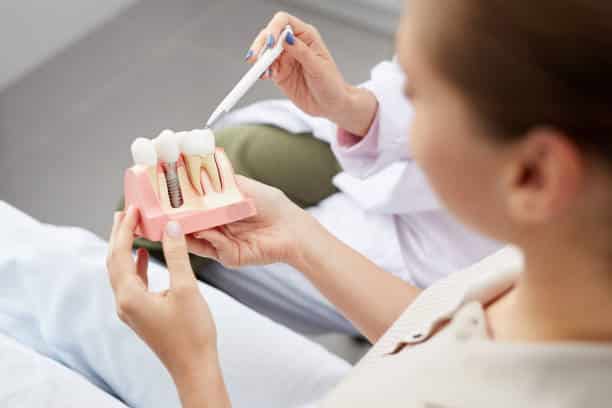
The post goes into the jawbone where the old root used to be. Over about three to six months, the bone grows onto the titanium and holds it firmly. Dentists call this osseointegration. After that, a small connector called an abutment is fitted to the post, and a crown, shaped and coloured to blend in with your other teeth, goes on top.
Goes into the jawbone where the old root used to be.
A small connector fitted once the bone has grown onto the post.
Shaped and coloured to blend in with your other teeth.
Who Is a Good Candidate for Dental Implants?
An implant tends to work well for people who:
When an Implant May Not Be the Right Fit Yet
Teenagers usually have to wait. The jaw keeps growing through the teenage years, so an implant is normally put off until that growth has finished. At the other end, being older isn’t a problem on its own. General health matters far more than age.
Gum disease has to be sorted out before an implant goes in, because it can shorten how long the implant lasts. Smoking slows healing and makes failure more likely. Poorly controlled diabetes, some medicines that affect the bones (including certain osteoporosis treatments) and past radiotherapy to the head or neck can also affect healing. So we’ll ask about your medical history before recommending anything.
Being told “not yet” doesn’t mean you’ll never get an implant. Often it just means fixing your gums, building up some bone, or getting your health sorted first.
Why Replacing a Missing Tooth Matters for Your Bite and Jawbone
A gap often doesn’t hurt. Most people just start chewing on the other side and get on with things. The changes happen slowly and quietly.
- The bone that held the root starts to shrink, because nothing is using it anymore
- The teeth on either side can lean into the space
- The tooth opposite can drift towards it
- Your bite can change, your jaw can start to ache, and the gap becomes harder to fix
Once the root has gone, the bone that held it starts to shrink because nothing is using it anymore. The teeth on either side can lean into the space, and the tooth opposite can drift towards it. Over time, your bite can change, your jaw can start to ache, and the gap becomes harder to fix. Because an implant sits in the bone like a real root, it helps keep that bone in place. A bridge or denture can’t do that.
The Dental Implant Process, Step by Step

We check your mouth, gums, and bone, take X-rays, go over your medical history, and talk through your options and costs.
The titanium post goes in under local anaesthetic and is left to bond with the bone for about three to six months.
When the implant is stable, a custom crown is made to match your teeth and fitted by your general dentist.
How Long Does Implant Treatment Take?
From the first appointment to the finished tooth, expect several months, mostly because the bone needs time to grow onto the post. If a tooth has to come out first, or you need bone grafting, it will take longer. We’ll give you a realistic timeframe at your consultation and talk about what can go in the gap while you heal.
Dental Implants Compared with Bridges and Dentures
| Dental implant | Dental bridge | Denture | |
|---|---|---|---|
| What it is | Titanium post in the jaw with a crown on top | Replacement tooth held by crowns on the teeth either side | Removable plate with replacement teeth |
| Fixed or removable | Fixed | Fixed | Removable |
| Affects neighbouring teeth | No | Yes, those teeth are shaped to hold the bridge | Partial dentures often clip onto natural teeth |
| Helps preserve jawbone | Yes | No | No |
| Surgery needed | Yes | No | No |
| Upfront cost | Usually the highest | Usually in between | Usually the lowest |
None of these is the “right” answer for everyone. If the teeth next to the gap already need crowns, a bridge can make a lot of sense. If you’re missing several teeth and need to keep costs down, dentures may suit you better. It depends on your mouth, your budget, and how you live.
Benefits and Risks to Weigh Up Before You Decide
An implant feels like your own tooth; it doesn’t lean on the teeth beside it, the implant itself can’t decay, and if you look after it, it can last a long time. Many people tell us the biggest change is being able to eat what they like and smile without thinking about it.
It is still surgery, though, and surgery comes with risks. Expect some swelling, bruising, and soreness for a few days. Less often, the area can get infected, or the implant doesn’t bond with the bone and has to come out. Occasionally, nerve irritation causes numbness, and implants in the upper back jaw can affect the sinus. Years down the track, the gum around an implant can become inflamed (peri-implantitis) if it isn’t kept clean. We’ll talk you through all of it before you decide.
Benefits
- Feels like your own tooth
- Doesn't lean on the teeth beside it
- The implant itself can't decay
- Can last a long time if you look after it
- Eat what you like and smile without thinking about it
Risks
- Swelling, bruising and soreness for a few days
- Less often, infection, or the implant doesn't bond and has to come out
- Occasionally, nerve irritation causing numbness
- Upper back jaw implants can affect the sinus
- Peri-implantitis if the gum around it isn't kept clean
Caring for Your Implant After Treatment
After the first few days, treat your implant like any other tooth. Brush twice a day, clean between your teeth with floss or interdental brushes, and keep coming in for check-ups so we can pick up any problems early.
For the first few days after surgery
- Eat soft foods and chew on the other side.
- Take pain relief as we've directed.
- Follow the cleaning instructions we give you, and call us if something doesn't feel right.
Understanding Implant Costs, Health Funds and Payment Plans
The price depends on how many teeth you’re replacing, whether you need bone grafting, and what type of crown you have, so we can’t give you one number here. What we can do is give you a treatment plan with the costs laid out before anything starts, so nothing catches you off guard.
Medicare doesn’t cover dental implants for most adults in Australia. If you have private extras cover, implants usually come under major dental, which often has a waiting period and a yearly limit, so check with your fund first. We’re a preferred provider for CBHS, Australian Unity, HCF, Medibank and Bupa, and you can claim on the spot with HICAPS.
If paying all at once isn’t realistic, we offer three payment-plan options, plus SuperCare. SuperCare helps eligible patients apply for early release of their superannuation on compassionate grounds. The Australian Taxation Office assesses those applications, and eligibility rules apply.
What shapes the cost





Nervous About Implant Surgery? How We Keep You Comfortable
Most people's first question is whether it will hurt. We numb the area with local anaesthetic, so during the procedure most people feel pressure rather than pain. If you're anxious, happy gas (nitrous oxide) can help you relax while you stay awake. We tell you what's coming before we do it, we agree on a signal to stop, and we go at your pace.
Talk to Us About Your Missing Tooth
If you're wondering whether an implant is right for you, book a consultation, and we'll look at your mouth and talk it through. You can book online, call 07 3824 4488, or come and see us at Shop 2/191 Vienna Rd, Alexandra Hills QLD 4161. We see people from all over the Redlands, from Capalaba to the west through to Cleveland to the east.

Got a question about implants we haven’t covered? Ask us. And if a friend or family member is trying to work out what to do about a missing tooth, feel free to share this with them.