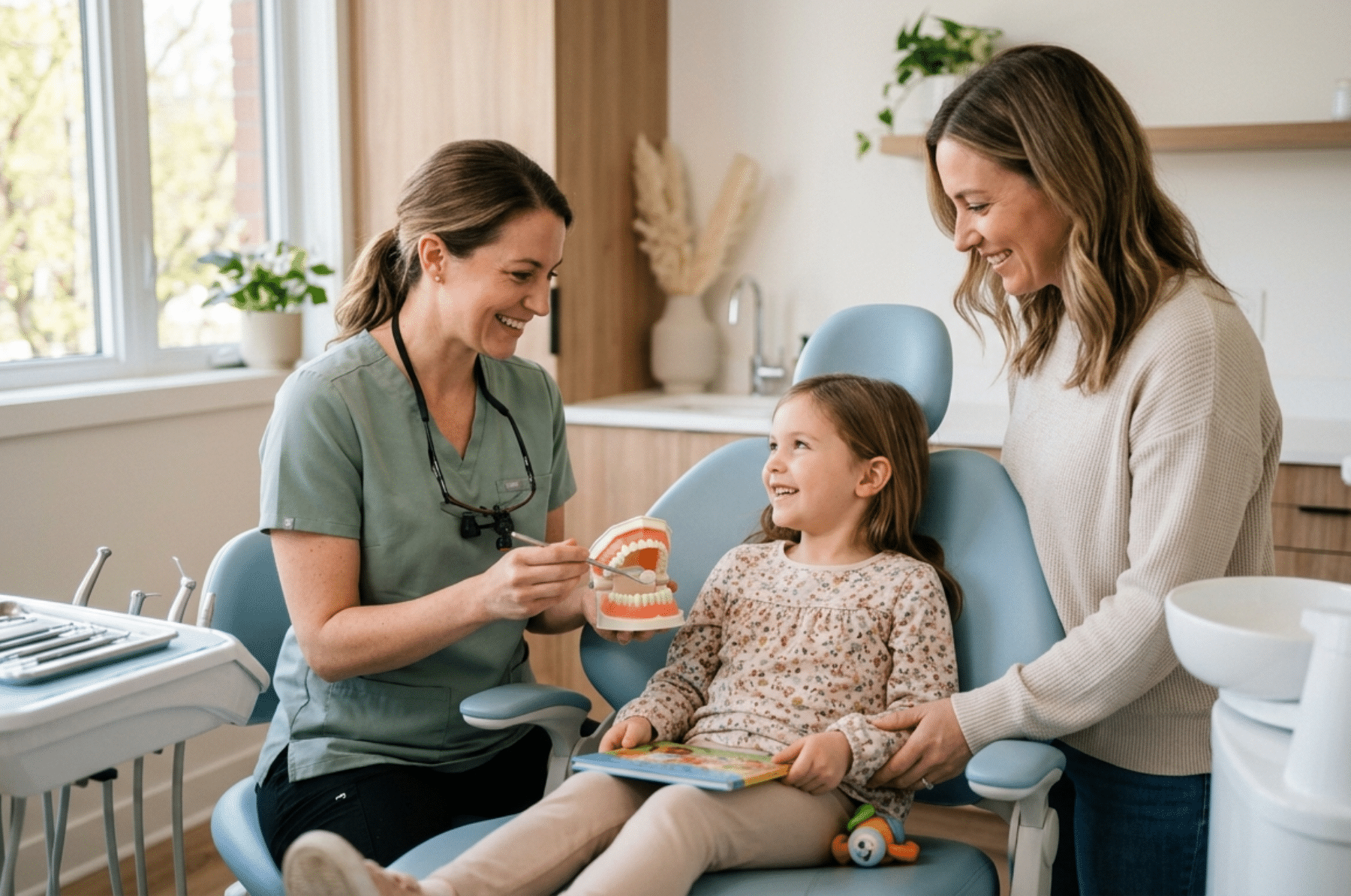
What should you actually expect when you bring your child to a kids dentist in Alexandra Hills for the first time? In short, a calm, unhurried visit where every tool and step gets explained before it is used, so your child never feels ambushed by the experience. If you are the parent lying awake worrying your child will scream in the chair and refuse to ever go back, take a breath. That is the exact fear we hear most often from Redlands parents, and it is exactly what our approach is built to prevent.
At a glance
- Book your child’s first visit around their first birthday, or within six months of their first tooth appearing.
- Eligible kids aged 2 to 17 can access care at no out-of-pocket cost through the Child Dental Benefits Schedule (CDBS).
- Happy Gas is available for children who need extra help staying relaxed.
- Mandarin, Chinese and Korean speaking dentists are on our team for families who prefer to discuss care in their own language.
What To Expect at Your Child’s First Dental Visit
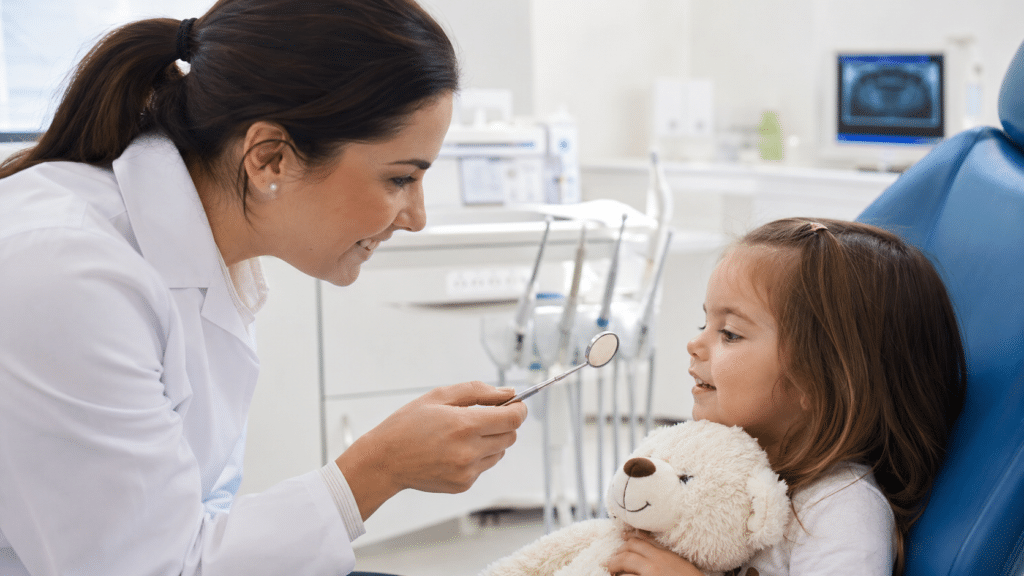
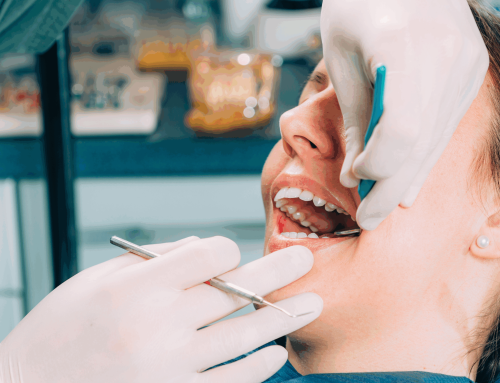
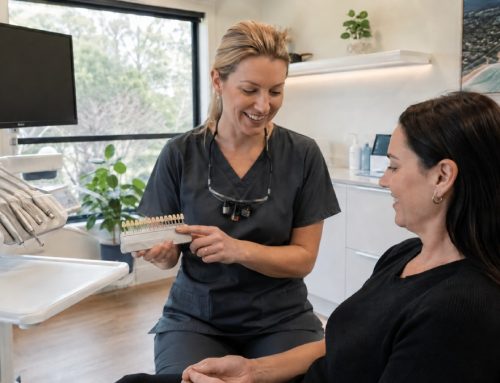
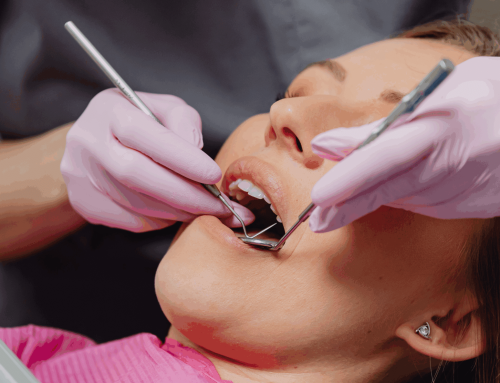
A first visit at Alexandra Hills Dental is deliberately low-key. There is no drilling, no lecture, and no pressure. We talk to your child at their level, show them the mirror and the little polishing brush before it goes anywhere near their mouth, and let them touch and look at tools if they want to. Music plays in the background, and the whole environment is designed to feel more like a friendly room than a clinical one. For a lot of kids, the first visit is really just about getting comfortable in the chair and building trust, nothing more.
First visit checklist for parents
| ✓ | Bring your Medicare card so we can check CDBS eligibility on the spot. |
| ✓ | Pack a comfort item, a favourite toy or blanket, if your child has one. |
| ✓ | Talk about the visit in simple, positive language beforehand. |
| ✓ | Let us know if your family speaks Mandarin, Chinese or Korean at home. |
When Your Child Should Start Seeing A Dentist
We recommend bringing your child in around their first birthday, or within six months of their first tooth appearing, whichever comes first. Starting early means we catch small issues before they become painful ones, and just as importantly, it means your child grows up seeing the dentist as a normal, unscary part of life rather than something that only happens when there is already a problem.
| Tooth | Usually appears | Usually falls out |
|---|---|---|
| Central incisor | 6 to 10 months | 6 to 7 years |
| Lateral incisor | 9 to 16 months | 7 to 8 years |
| Canine (eye tooth) | 16 to 22 months | 9 to 12 years |
| First molar | 13 to 19 months | 9 to 11 years |
| Second molar | 25 to 33 months | 10 to 12 years |
General ranges only, every child develops at their own pace. Ask us if you would like your child’s own eruption pattern checked.
42%
of Aussie kids 5 to 10
Why early visits matter
According to the Australian Institute of Health and Welfare, around 4 in 10 Australian children aged 5 to 10 have experienced decay in their baby teeth, and roughly 1 in 4 have at least one baby tooth with untreated decay. Regular check-ups from an early age are one of the simplest ways to keep your child out of that statistic.
Source: AIHW, Oral health and dental care in Australia.
How We Help Nervous or Anxious Children Feel Calm
Kids pick up on nerves fast, sometimes from a parent’s own dental anxiety, sometimes from a story a friend told them at school. We slow everything down, explain each step in plain language a child can follow, and use positive reinforcement so good behaviour gets noticed and encouraged. If your child needs a bit of extra help staying relaxed for a procedure, Happy Gas is available as a gentle sedation option for anxious children as well as adults. The goal is not just getting through one appointment, it is making sure your child walks out happy to come back next time.
Free Kids Dental Under The Child Dental Benefits Schedule
Here is a fact worth knowing if you have not looked into it: eligible children aged 2 to 17 can access dental care at no cost through the Child Dental Benefits Schedule, a Medicare programme that helps families cover basic dental services for kids. It is not something we advertise loudly enough, but it means routine checks, cleans, and some fillings can be covered for eligible families rather than coming out of pocket. If you are not sure whether your child qualifies, ask us when you call. It only takes a couple of minutes to check.
| Detail | What it means for your family |
|---|---|
| Who qualifies | Children aged 2 to 17 who meet Medicare eligibility, generally tied to receiving certain government payments. |
| Benefit cap | Up to $1,158 per eligible child over a two consecutive calendar year period (2026 rate, indexed annually). |
| What it covers | Check-ups, x-rays, cleaning, fissure sealants, fillings and some other basic dental services. |
| What it does not cover | Orthodontics and cosmetic dental treatment are excluded. |
| How to claim | We bulk bill electronically on the spot, no need to pay upfront and claim later. |
CDBS caps are indexed on 1 January each year, always confirm your child’s current balance with Medicare or with us before your visit.
We also support HICAPS claiming on the spot for families with private health cover, so you are not stuck paying upfront and waiting on a reimbursement. Combined with CDBS eligibility for younger patients and payment plans for bigger treatment needs, cost genuinely should not be the reason a check-up gets put off.
We are a preferred provider for:
CBHS | Australian Unity | HCF | Medibank | Bupa
Common Signs Your Child May Need A Dental Check-Up
A few signals worth watching for between regular visits:
If you spot any of these, it is worth booking a check sooner rather than waiting for the next scheduled visit. None of these signs mean you have missed something as a parent, kids’ teeth change quickly, and a lot of these issues are picked up far more easily by a dentist than by checking at home with a torch and a lot of wriggling.
Preventing Cavities With Early Oral Hygiene Habits
Prevention really is better than a cure, and cavities in kids are almost always preventable with the right habits started early. We talk parents through brushing technique for little ones who cannot yet manage it themselves, the right amount of fluoride toothpaste for different ages, and cutting back on sugary snacks and drinks between meals. A six-month scale and clean routine, alongside daily brushing and flossing at home, does most of the heavy lifting here.
| Age | Amount of fluoride toothpaste | Frequency |
|---|---|---|
| Under 3 years | A smear, about the size of a grain of rice | Twice daily, supervised |
| 3 to 6 years | A pea-sized amount | Twice daily, supervised |
| 6 years and over | A pea-sized amount | Twice daily, brushing checked periodically |
Fluoride Treatments and Sealants For Growing Teeth
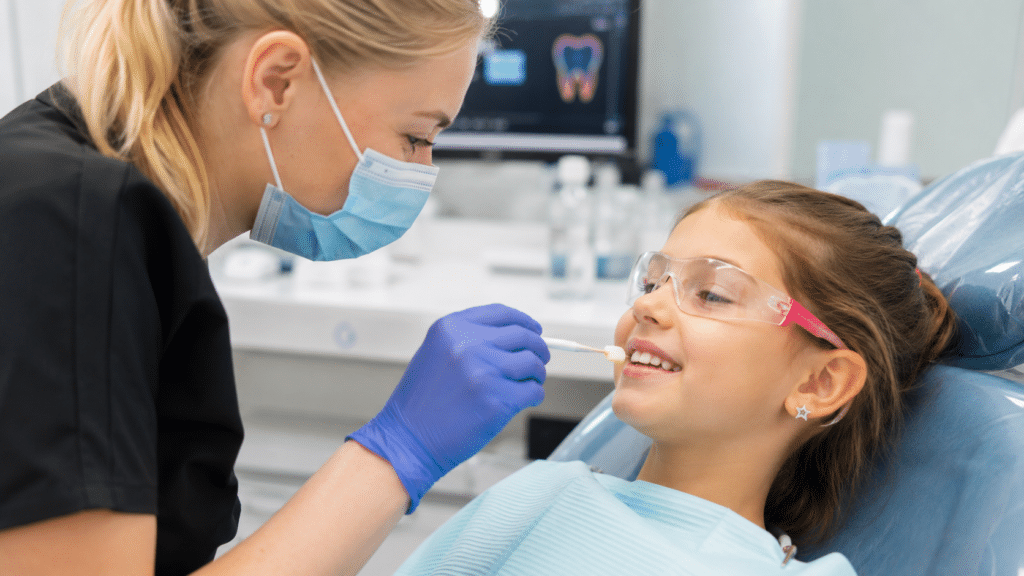
For kids with new adult teeth coming through, fluoride treatments and fissure sealants add an extra layer of protection. Fluoride strengthens the enamel against decay, while sealants fill in the tiny grooves on the chewing surfaces of back teeth, the exact spots where food and bacteria like to hide and cavities like to start. Both are quick, painless, and can meaningfully cut the risk of your child needing a filling down the track. Both treatments are also included under the CDBS for eligible children.
What Happens If Your Child Needs A Filling Or Extraction
If a check-up turns up a cavity, most fillings in kids are straightforward and quick, done gently with plenty of explanation along the way so your child knows what is happening at each step. Extractions are only ever a last resort, and we will always talk you through the alternatives first. Whatever the treatment, the same principle applies: explain, reassure, and never rush a nervous child.
Preparing Your Child For Their Dentist Appointment
A little preparation at home goes a long way. Talk about the visit in simple, positive terms rather than avoiding the topic or over-explaining it. Avoid words like “hurt” or “pain” and stick to describing it as the dentist “counting teeth” or “giving them a clean.” If your child has a comfort item, bring it along. And if it is back-to-school season, it is a great trigger to get the whole family’s check-ups booked before term starts, covering cleans, sealants, braces checks and mouthguards in the one visit.
We also understand that fitting appointments around school pickups, sport, and work is not always easy for busy Redlands families. We offer appointment times across the week to make booking around school and work commitments a bit more manageable, and our reception team is happy to work with you on timing if a school reminder has landed and you need something sorted before term starts.
Three Simple Steps To A Comfortable First Visit
|
1
|
Book Early. Get in around your child’s first birthday or within six months of their first tooth, so there is no problem to fix yet, just a habit to build. |
|
2
|
Keep Language Simple and Positive. Talk about the visit at home in calm, everyday terms, and let us do the explaining once you are in the chair. |
|
3
|
Celebrate the Visit. Praise your child afterwards, whatever happened in the appointment, so the dentist stays linked to a positive experience in their mind. |
Why Regular Check-Ups Matter For Children’s Oral Health
Roughly every six months is the standard rhythm we recommend for children, the same as adults. Regular check-ups catch small issues while they are still easy and painless to treat, keep an eye on how adult teeth are coming through, and build a track record of positive visits that pays off well into the teenage years. Skipping check-ups does not save money in the long run, it usually just delays a bigger, more expensive problem.
Nationally, around 1 in 10 Australian children aged 6 to 14 have at least one permanent tooth with untreated decay, a proportion that is noticeably lower among children whose last visit was a routine check-up rather than a visit prompted by a problem. Staying on the six-month rhythm is a simple, low-cost way to keep your child on the better side of that gap.
Source: AIHW, Oral health and dental care in Australia.
Supporting Mandarin, Chinese and Korean Speaking Families
We know a lot of Redlands families feel more at ease discussing their child’s care in their own language, and our team includes Mandarin, Chinese and Korean speaking dentists. Whatever language your household speaks at home, we will take the time to explain treatment clearly and make sure nothing gets lost in translation, especially when it comes to a nervous child and an even more nervous parent.
Quick Answers For Parents
| Question | Short answer |
|---|---|
| Is my child’s first check-up really free? | For eligible children aged 2 to 17, yes, basic services are covered up to the CDBS cap. Ask us to confirm eligibility before your visit. |
| What if my child cries or refuses to open their mouth? | Completely normal, especially at the first visit. We slow down, let them look and touch, and never force treatment. |
| Do you see children with high anxiety or dental phobia? | Yes, Happy Gas is available for children as well as adults who need extra help staying relaxed. |
| Can we be seen in Mandarin, Chinese or Korean? | Yes, our team includes Mandarin, Chinese and Korean speaking dentists. |
Booking Your Child’s Appointment in Alexandra Hills

If your child is due for a check-up, showing early signs of a problem, or you are simply looking for a Redlands dentist who will not make either of you dread the visit, get in touch with our Alexandra Hills team. We see families from right across Capalaba, Cleveland, Victoria Point and beyond, we are a preferred provider with CBHS, Australian Unity, HCF, Medibank and Bupa, and we offer payment plans for larger treatment needs. Call, email, or book online, and let us get your child’s smile off to a calm, healthy start.